Why Retatrutide Purity Testing Certificates of Analysis Matter More Than the Vial Label
A certificate of analysis, or COA, is a lab’s written report on what is actually in a sample, and for retatrutide, such as Kylo’s GLP 3 RT, it’s the single best document for checking purity claims. Read it for four things: the identity of the compound, the purity percentage, the testing method, and a batch number that matches your vial. If any of those are missing, the paper isn’t doing its job.
Retatrutide is an investigational compound, which means it isn’t an approved medication, and there’s no standard consumer label to lean on. That makes the COA carry far more weight than it would for, say, a household product. Good paperwork is specific: a named lab, a test date, results tied to one batch. Vague paperwork looks polished but says nothing.
Think of it the way a careful shopper reads an ingredient list. The same habit that helps people check energy claims on a home product applies here: verify, don’t assume. A supplier’s listing for something like this is only as trustworthy as the testing documentation behind it, so knowing what a real COA contains lets you judge any batch on its evidence.
This guide covers the tests that matter, a simple checklist for reading a COA, and the red flags that signal unreliable documentation. It’s educational only, with no sourcing, dosing, or usage advice.
What Retatrutide Is and Why Its Purity Matters
Retatrutide is an investigational peptide, which means it is still being studied rather than sold as a treatment. It has appeared in clinical research, but it is not FDA-approved, and that detail shapes everything else in this article.
A peptide is simply a short chain of amino acids, the same building blocks your body uses to make proteins. Peptides are delicate. They can break down with heat, light, or time, and they can pick up impurities during manufacturing. A “research batch” is one production run of a compound, made at one time and labeled with a lot number. Everything about that batch, including how clean it is and how much of the real molecule it contains, can differ from the next run.
That is why purity sits at the center of any research compound. Three problems come up again and again:
– Contaminants, such as leftover chemicals or microbes, that were never meant to be in the vial.
– Degraded molecules, where the peptide has partly broken apart and is no longer what the label says.
– Incorrect amounts, where the vial holds more or less than claimed.
Any of these can quietly undermine results. In unregulated markets, they can also create real safety concerns, because nobody is required to catch them before the product reaches a buyer.
Approved medications are made under strict manufacturing oversight, with required testing at multiple steps. Research-labeled materials don’t get that same scrutiny. A vial can say almost anything on its label, and no regulator has checked it. Independent, batch-specific documentation is the closest thing a careful reader has to evidence, which is exactly why the rest of this article focuses on how to read it.
What a Certificate of Analysis Actually Is
Batch-Specific vs. Generic Documents
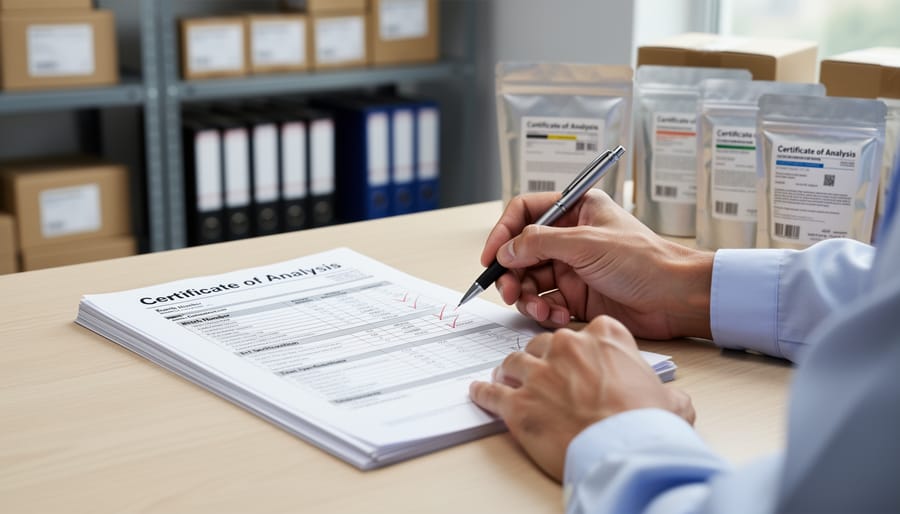
A certificate of analysis only means something when it describes the exact vial in your hands. Every batch of a compound is made in a single production run, and that run gets a lot number, usually printed on the vial label. The COA should carry that same lot number, so you can match the two like a key to a lock.
Why does this matter? Two batches from the same maker can differ in purity, even when the recipe is identical. A report on last spring’s batch tells you nothing about this one. Think of it like a produce label with someone else’s harvest date stamped on it.
Watch for reports with no lot number, no test date, or a date that falls well before the vial could have been made. A document that shows up unchanged across several different products or batches is another sign it was recycled. A generic file can look professional and still prove nothing about what’s inside your vial.
In-House vs. Independent Lab Reports
Think about who benefits when a test comes back clean. If the company selling a product is also the one running the test and writing the report, it has every reason to like the result. That doesn’t mean in-house reports are dishonest, but nothing outside the company can confirm them, either.
An independent lab has no stake in the sale. It gets paid to report what it finds, not to flatter the seller, and its reputation depends on accurate results. That separation is what turns a document from a claim into evidence.
Independence still isn’t a guarantee on its own. Look for a lab with a verifiable name, contact details, and, ideally, accreditation to a recognized standard such as ISO/IEC 17025. A report from a lab you can’t trace tells you very little.
The Tests Behind the Numbers
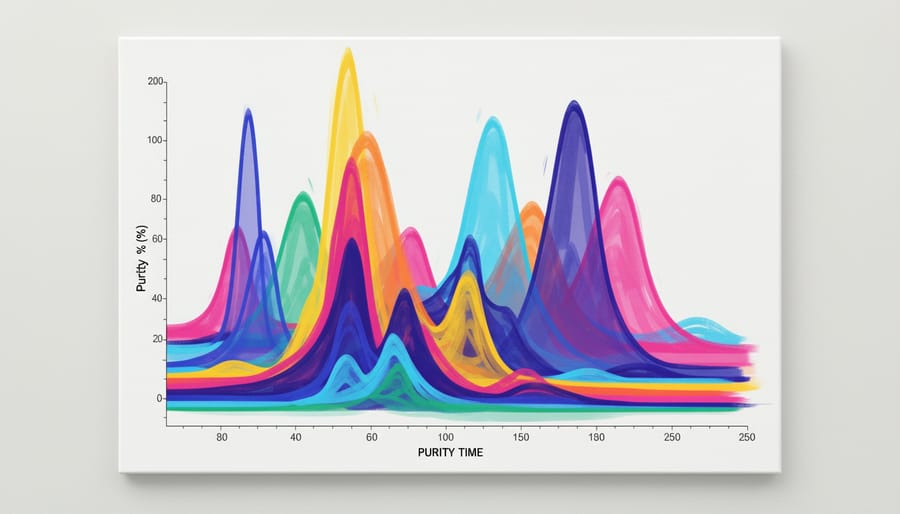
Purity vs. Identity: Two Different Questions
A COA answers two separate questions, and it helps to keep them apart. The first is “how clean is this sample?” The second is “is it actually the right molecule?” A report can look strong on one and say nothing about the other.
HPLC speaks to the first question. It separates a sample into its components, and the resulting purity percentage suggests how much of the material is the target compound versus everything else. Mass spectrometry speaks to the second. It measures molecular weight, which helps confirm the main peak is retatrutide and not a look-alike.
- HPLC
- High-performance liquid chromatography, a method that separates a sample into parts to estimate how pure it is.
- Chromatogram
- The graph HPLC produces, with each peak representing a different component of the sample.
- Mass spectrometry
- A technique that measures molecular weight to help confirm a compound’s identity.
- Net peptide content
- The share of the vial’s contents that is actual peptide, as opposed to water, salts, or other leftovers.
Neither test is enough alone. A sample can be impressively “pure” and still be the wrong compound, or the right compound with unnoticed impurities. Together, they paint a far more trustworthy picture.
Contaminant and Safety Testing
Purity percentages get the headlines, but a clean HPLC peak says nothing about what else might be in the vial. That’s where contaminant and safety tests come in, and it’s the same logic behind why safety testing matters for anything that touches soil, water, or the body.
Endotoxin testing looks for fragments of bacterial cell walls, which can trigger fever and inflammation even when no living bacteria remain. Sterility testing checks whether viable microbes are present. Heavy metals testing screens for lead, arsenic, cadmium, and mercury, which can sneak in through raw materials or equipment. Residual solvent testing detects leftover chemicals from manufacturing, such as acetonitrile or other solvents used during peptide synthesis.
A COA that lists only purity and mass is not necessarily fraudulent, but the gaps are worth noticing. If these tests are missing, you have no evidence either way about contamination, and silence is not the same as a clean result.
How to Read a COA Step by Step

Reading a COA feels intimidating at first, much like reading a nutrition panel for the first time. But it’s a learnable skill, and you don’t need a chemistry degree to spot the basics. Work through the document in a consistent order, and the picture gets clearer quickly.
- Identify the lab. Find the testing laboratory’s name, address, and contact details. Look for any accreditation, such as ISO/IEC 17025, and check whether the lab is a separate company from the seller.
- Match the lot number. The lot or batch number on the report should be identical to the one on the vial you’re evaluating. A close match isn’t a match.
- Check the dates. Confirm both the test date and the report date. Dates should be plausible and in a sensible order, and a very old report may not reflect how a batch looks today.
- Look at the raw data. Find the chromatogram (the HPLC graph) and the mass spectrometry output, not just the headline purity number. A clean report shows one dominant peak and a molecular weight that fits the compound.
- Compare methods to claims. See which tests were actually run, then ask whether they support what’s being claimed. A purity figure with no identity confirmation answers only half the question.
- Verify the source. Ask whether the lab can confirm the report directly, so you aren’t relying on a PDF alone.
A few habits make this easier. Treat the headline percentage as a starting point, not a verdict. Two reports can both say 99% and tell very different stories once you look at the data behind them. A tidy chromatogram with a single sharp peak is reassuring, while a crowded graph with several unexplained peaks deserves a closer look.
Don’t worry if some terms still feel unfamiliar after one read. Keep a short glossary handy and revisit it each time. Reading a few reports side by side teaches you what normal looks like, and that makes anything unusual stand out. Careful reading is a skill, and it grows with practice.
Red Flags That Should Make You Pause
Not every odd detail means a document is fake, but some patterns deserve a closer look before you trust anything it says. Think of these as prompts to ask questions, not reasons to assume the worst.
Missing or mismatched lot numbers. A COA that doesn’t name a lot, or names one that differs from the vial in front of you, can’t tell you anything about that vial. Without the match, it’s just a nicely formatted page.
Identical reports for different batches. If two separate lots show the same purity figure, the same peak shape, and the same dates, the report may have been reused. Real batches vary, even if only slightly.
A purity number with no raw data. A headline percentage means little without the chromatogram and mass spectrometry results behind it. Legitimate labs include them, and a report that offers only a tidy figure is asking you to take its word.
An edited-looking PDF. Watch for mismatched fonts, uneven spacing, blurry logos, or text that appears pasted over other text. Any of these can signal that a document was altered after the lab produced it.
A lab you can’t verify. If you can’t find the lab’s website, accreditation, or a way to contact it, treat the report with caution. A real lab is usually easy to confirm.
Too-good-to-be-true results. A flat 100% purity claim is unusual. Analytical methods have limits, and most credible reports show results just under that mark.
One flag alone may have an innocent explanation, such as a clerical slip. Several together are harder to dismiss. The goal is informed skepticism: asking sensible questions, checking what can be checked, and letting the evidence, rather than the formatting, earn your confidence.
Limits of a COA and the Bigger Picture
A COA is a snapshot, not a guarantee. It tells you what a lab found in one batch on the day it was tested, and that’s where its authority ends. It can’t verify how the material was stored or shipped afterward, and peptides are sensitive to heat, light, moisture, and repeated handling. A vial that was spotless in the lab can degrade long before anyone opens it.
It also says nothing about safety for human use. Retatrutide is an investigational compound, and a clean purity result doesn’t establish that it’s safe or appropriate for anyone to take. Nor does a COA replace regulatory oversight. Approved medicines go through manufacturing inspections, clinical review, and ongoing monitoring that a single lab report simply can’t match.
That’s why responsible handling and storage matter as much as the paperwork. Keeping materials as the lab or supplier specifies, labeling them clearly, and knowing how to safely handle materials and dispose of them properly all help preserve quality and protect people and the environment.
Stay current, too. Guidance on investigational compounds changes as research and regulation evolve, so check reputable public health and regulatory sources rather than relying on a seller’s summary.
There’s a sustainability angle here as well. Verifying quality before you buy is one practical way to reduce waste, because degraded or mislabeled material often ends up in the trash. The same thinking that helps you avoid discarding quality goods at home applies here: check first, and less goes to waste.
Common Questions About Retatrutide Testing Documents
Readers tend to ask the same handful of things once they start looking at these documents, so here are short answers to the most common ones.
Does a high purity percentage mean a product is safe?
No. A purity figure from HPLC only describes how much of a sample is the target molecule compared with other detectable compounds. It says nothing on its own about endotoxins, sterility, or whether the material is suitable for human use.
How often should testing be repeated?
Every new batch needs its own report, since a COA only describes the lot it was run on. Older results also can’t speak to how the material was stored afterward, so the date on the document matters.
Can a COA be verified directly with the lab?
Often, yes. Reputable labs can confirm a report’s lot number, test date, and results if you contact them using details you’ve found independently, not the ones printed on the document. If a lab can’t be reached or won’t confirm a report, treat that as a warning sign.
Is an in-house COA worthless?
Not worthless, but it deserves more caution. A report issued by the seller has no outside check on it, which is why independent third-party results carry more weight.
Think of these answers as a starting point, not a finish line. Retatrutide remains an investigational compound, and nothing here is guidance on obtaining or using it. The habit worth building is simply asking, “What does this document actually prove, and what does it leave out?”
A vial label is a claim. A batch-specific, independently verified certificate of analysis is the evidence that lets you test that claim. The label tells you what someone says is inside. The COA, read carefully, shows whether a qualified lab found support for it: a matching lot number, a clean chromatogram, a mass spec result that confirms the right molecule, and a lab you can actually verify.
It’s worth saying once more that retatrutide remains an investigational compound. Nothing here is an endorsement, and learning to read a lab report isn’t a green light for anything. It’s about being an informed reader who understands what documentation can and can’t prove.
Remember the limits, too. A COA doesn’t guarantee safety, and it can’t tell you how a material was stored after testing. It’s one piece of the picture, alongside reputable public health and regulatory sources.
The good news is that this skill travels well. The same curiosity that lets you question a purity percentage will serve you when you’re sizing up a “100% natural” cleaner or a vague eco-claim. Keep asking where the evidence is. Careful reading is a habit anyone can build, and it pays off every time.